Lawn care route economics
Route density turns windshield time into a pricing input.
Two similar lawns can have different cost floors when one sits near the rest of the route and the other adds a long, unproductive leg. The difference is time the route can no longer sell elsewhere.
What route density means
Route density describes how efficiently recurring stops fit together in a service cycle. A denser route generally spends a larger share of its paid capacity producing work and a smaller share driving between stops. It is not simply the number of customers on a list.
Geography matters, but so do gates, parking, loading, schedule windows, and the order of stops. The useful input is the repeatable time the stop actually adds to a normal route cycle.
A ten-minute drive-time example
These values are illustrative examples, not recommended rates, margin targets or industry averages.
Suppose a recurring stop takes 38 minutes on site and 4 minutes for access and setup. On the current route it adds 10 minutes of driving. In a tighter scenario it would add none of that extra leg. At an entered field-time value of $38 per hour, ten minutes represents about $6.33 of time cost.
At a 22% target margin with no percentage payment fee, divide the unrounded time-cost saving by (1 − 0.22): $6.333333… ÷ 0.78 lowers the unrounded modeled price floor by about $8.12. This holds other per-visit costs constant, before any change in vehicle cost or overhead allocation.
If percentage payment fees apply, subtract their decimal rate from the denominator too: time-cost difference ÷ (1 − percentage fee rate − target margin). The percentage fee and target margin together must be below 100%. Keep unrounded amounts through the calculation.
Quoturf rounds each scenario's complete required price up to the nearest cent, then compares those rounded prices. That comparison can differ by a cent from rounding the difference on its own. This is a scenario comparison—not a recommended discount, local market rate or earnings promise.
Allocate each route leg once
Define the complete service cycle before allocating driving: the outward leg to the first stop, travel between stops, and the return leg after the last stop. Keep the same boundary in both scenarios so a shorter drive is not just an omitted leg.
Double-counting drive time can make every stop look worse than the route actually performs. Omitting it can make scattered work look better than it is. Choose a consistent method: assign each leg to one stop, or allocate the route’s total drive time across the stops in that cycle. Document the method and use it consistently.
Add the allocated drive minutes back together and check that they equal the recorded driving total for that same cycle. Keep service and setup minutes separate. Once driving is allocated to the stops, do not add the same route total again when reviewing them together.
Use the route board after pricing the stops
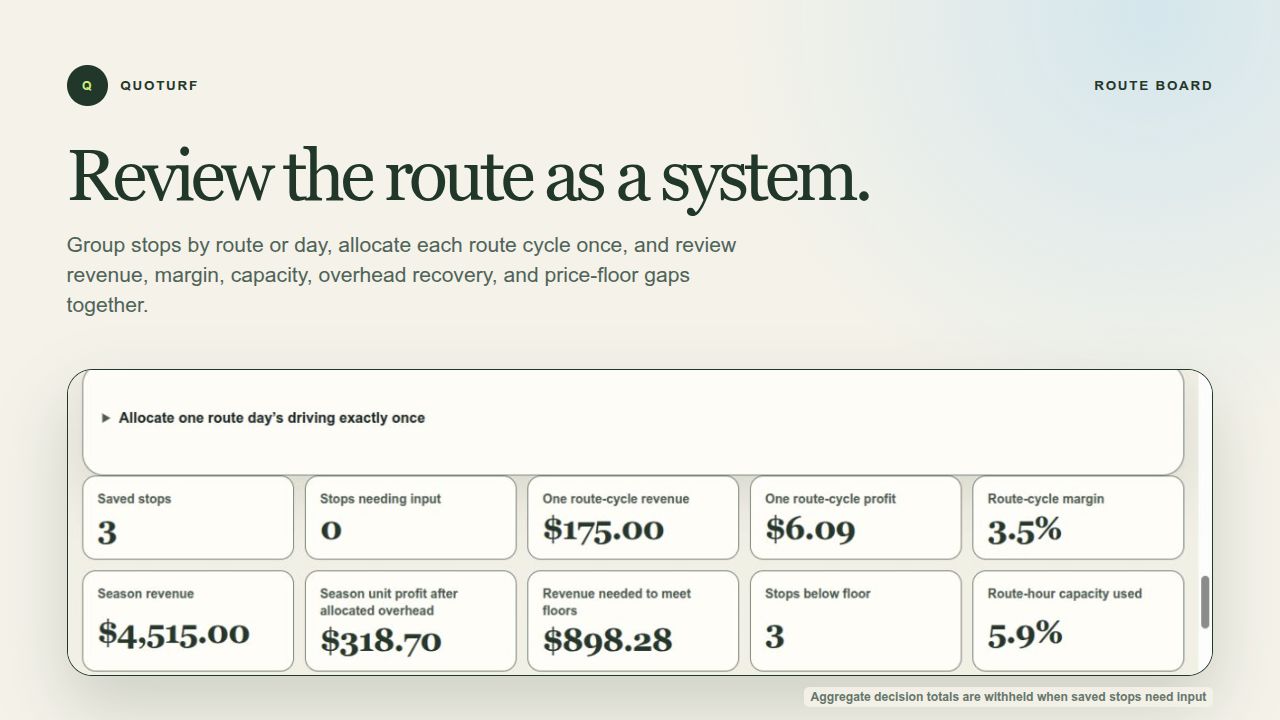
A stop can clear its own modeled floor while the route still fails to recover the full annual overhead. A route review should therefore compare saved stops together: route-cycle revenue, route hours, direct costs, owner pay or labor, overhead recovery, and the modeled remainder.
Quoturf’s full offline software connects those inputs so an edit to a stop flows through the route-level review. It does not create driving directions or claim to optimize the route.
Questions to test before changing a price
- Is the drive-time estimate based on a normal route cycle?
- Are access, loading, and setup counted separately and only once?
- Does the route-day group contain stops actually serviced together?
- Would a tighter scenario be operationally realistic?
- Does the current route recover its full modeled overhead?
- Do completed visits support the time assumptions?